About Tele.Style
How to Write Telegram Posts Based on Your Own Materials: RAG and the Knowledge Base in Tele.Style
Sergey Vendin
AI can write polished copy, but it does not know the facts about your business, products, or expertise. We explain how the knowledge base and RAG in Tele.Style let you create Telegram posts based on your own documents, website pages, and notes—without making up details.
How to Write Telegram Posts Based on Your Own Materials: RAG and the Knowledge Base in Tele.Style
You can ask an AI model:
Write a post about our product.
And get a perfectly convincing piece of copy.
The problem is that AI does not know your product on its own.
It has not read your internal documentation, seen your client presentation, learned your service terms, memorized your website, or taken part in your company’s projects.
If those details are not included in the prompt, the model starts relying on general knowledge and the most likely wording.
That may sometimes be acceptable for a post about productivity.
For content about a specific product, company, or professional topic, it is risky.
That is exactly why Tele.Style introduced the Knowledge Base: you upload your own materials, and AI uses them as a source of facts when preparing posts.
Technically, this approach is called RAG—Retrieval-Augmented Generation.
But the name of the technology matters less than what changes in practice:
instead of simply being told to “write something insightful about this topic,” the AI first searches your materials for information and only then writes the post.
The Problem with Standard AI Generation
Imagine a company that makes industrial equipment.
It has:
- a website;
- a PDF catalog;
- technical manuals;
- a product presentation;
- answers to frequently asked customer questions;
- dozens of completed projects.
The writer asks the AI:
Write a post about the benefits of our monitoring system.
If the model has not received those materials, all it knows is the wording of the prompt.
The result is predictable:
- “improves efficiency”;
- “saves time”;
- “supports better decision-making”;
- “a modern solution for businesses.”
These claims may be true, but they say almost nothing about this particular product.
There is also a more serious risk: the AI may try to fill in the gaps on its own.
For example, it might add:
- a feature that does not exist;
- an unverified figure;
- a nonexistent integration;
- an incorrect specification;
- an overly bold marketing claim.
The more specialized the subject, the more obvious this problem becomes.
RAG in Plain English
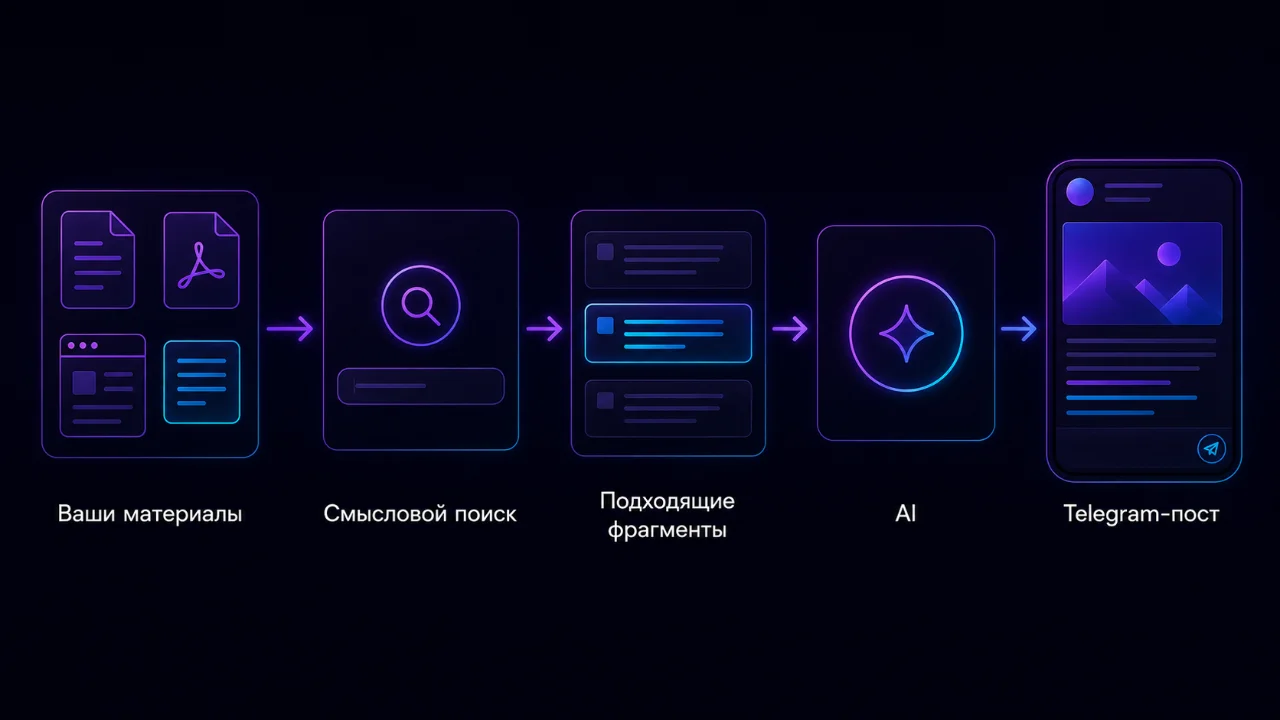
Standard generation looks roughly like this:
task → AI → text
RAG adds another stage before generation:
task → search your knowledge base → relevant passages → AI → text
You do not need to send the AI an entire 100-page manual every time.
The system finds the parts of your materials that are relevant to the upcoming post.
For example, your knowledge base might contain:
- a company presentation;
- product documentation;
- five articles;
- an FAQ page;
- descriptions of two case studies.
You specify a topic:
Why is automatic backup not a substitute for a disaster recovery plan?
Tele.Style searches the knowledge base for passages specifically related to backups, recovery, and disaster scenarios.
The AI then receives the retrieved context and writes a post based on it.
It simply does not need the other materials at that point.
How It Works in Tele.Style
The process has two parts:
- you create a knowledge base once;
- you specify which content categories should use it for generation.
Step 1: Add Your Materials
In the “Knowledge Base” section, you can add a source in three ways.
File
Supported formats:
- TXT;
- Markdown;
- PDF;
- DOCX.
The maximum size of a single file is 20 MB.
PDFs must have a text layer. If a document consists only of scanned pages, Tele.Style does not attempt to recognize the images as text.
This is intentional: it is better to clearly state that the material cannot be read reliably than to silently introduce OCR errors into the knowledge base.
Website Page
You can enter a regular URL:
https://example.com/product
Tele.Style retrieves the page text and adds it to the knowledge base.
This is a convenient way to connect:
- product pages;
- documentation;
- FAQs;
- articles;
- service descriptions;
- public case studies.
Plain Text
Sometimes there is no separate file at all.
For example, you may want to give the AI:
- a company description;
- editorial guidelines;
- an expert’s biography;
- a list of facts;
- an internal note;
- a project description.
You can paste this material directly into Tele.Style and give it a clear name.
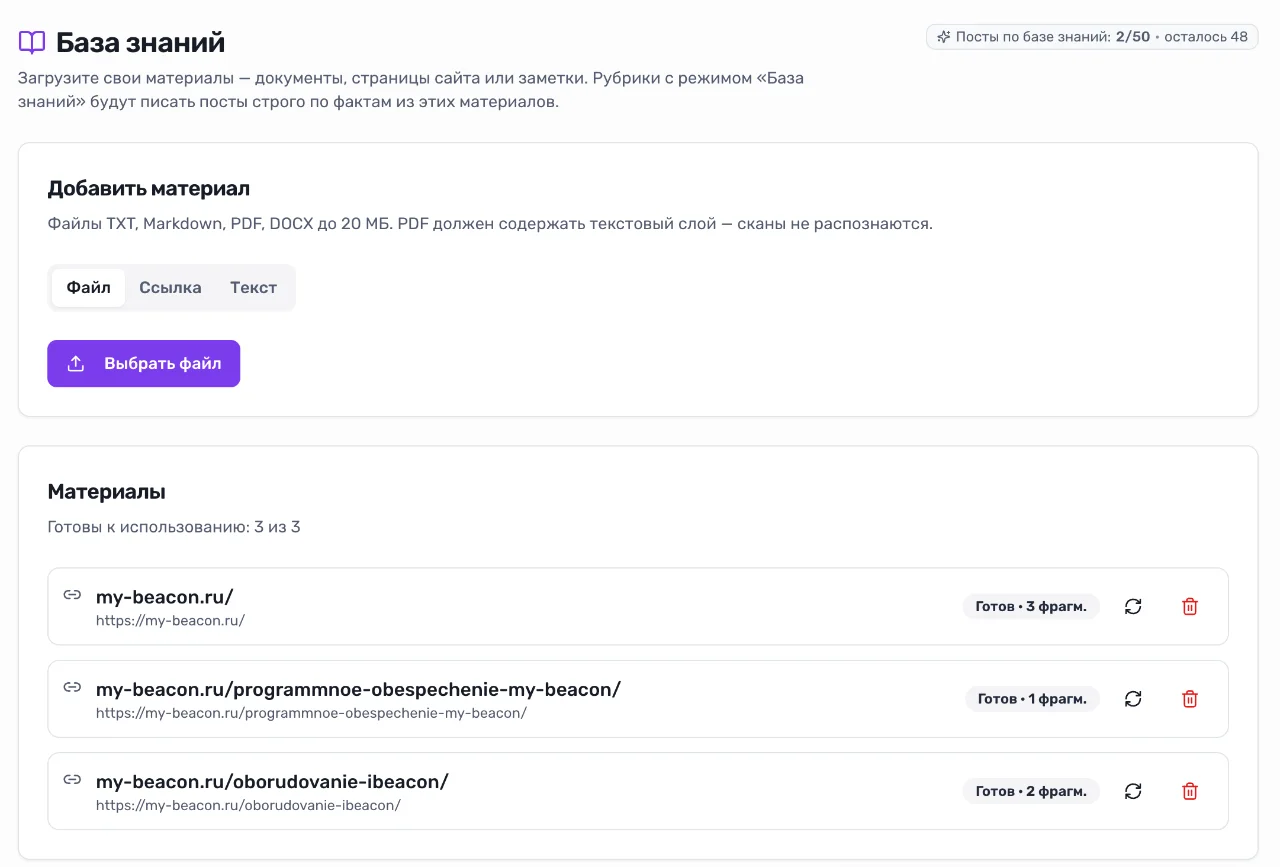
You can add a file, a website page, or plain text to the knowledge base.
What Happens After Uploading
This is where RAG itself begins.
Tele.Style does not store a document as one enormous block of text that is then sent to the model in full every time.
The material is:
- extracted from the file or page;
- cleaned;
- split into small, meaningful passages;
- each passage is converted into a mathematical representation—an embedding;
- the passages are indexed for subsequent semantic search.
This makes it possible to search for information by meaning, not just by exact word matches.
For example, the query might be phrased as:
What problems arise when implementing the system?
While the document says:
The main challenges during integration are related to the quality of the source data.
The wording is different, but the meaning is similar. Vector search helps the system find this passage.
Users do not need to manage embeddings, indexes, or search queries manually—all of this happens inside Tele.Style.
Step 2: Connect the Knowledge Base to a Content Category
The content category editor includes a setting called:
“Where do post facts come from?”
For a standard AI content category, the model generates material based on the category instructions.
For a news workflow, facts come from an external source.
In “Knowledge Base” mode, your own materials become the source.
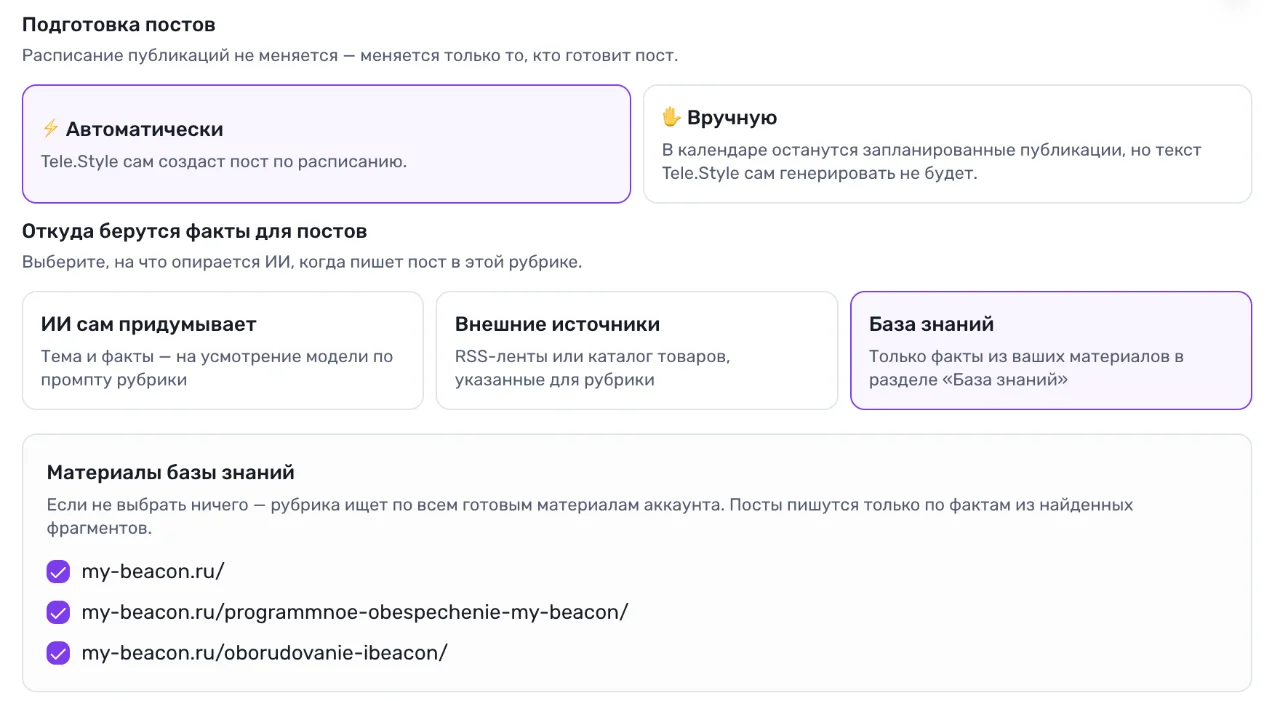
For a specific content category, you can specify that facts should come from the knowledge base.
You can select specific documents.
For example:
The “Case Studies” category
uses only:
Кейс клиента A.pdf;Кейс клиента B.docx;- the page featuring completed projects.
While:
The “About the Product” category
uses:
- documentation;
- the pricing plan description;
- the FAQ;
- the product page.
If you do not select anything separately, the category can search across all processed materials in the knowledge base.
This lets you maintain one large knowledge base while giving different content categories access to different areas of context.
What Happens When a Post Is Generated
Suppose you have a content category called:
Implementation in Practice
Its instructions say:
Write short, practical posts for technical leaders. Choose one specific problem, explain its cause, and show the solution. Do not use promotional language.
Tele.Style needs to prepare the next post.
First, the system creates a search topic.
If the writer has specified a particular topic for the post, that topic is used.
For example:
Mistakes when migrating data between systems.
Tele.Style then searches the selected knowledge base materials for the most relevant passages.
Only the retrieved context is sent to the model along with the content category instructions.
This creates an important separation:
the knowledge base provides the facts;
the content category prompt determines how those facts are turned into a post.
These are two separate tasks and should not be mixed together.
The AI Receives Relevant Context, Not the Entire Document
This is one of the main differences between RAG and simply “pasting all the documentation into the prompt.”
Imagine a knowledge base containing several hundred pages.
Most of it is completely unnecessary for any given post.
If you send everything to the model at once:
- costs increase;
- generation takes longer;
- useful information gets lost among irrelevant material;
- the model has more difficulty deciding what to emphasize.
Tele.Style runs a search first.
Only the most relevant passages are selected for generation, and the total amount of context is limited.
As a result, the AI works not with the entire library but with a small selection of materials directly related to the upcoming post.
The Main Rule: Facts Must Come Only from the Knowledge Base
In RAG mode, Tele.Style deliberately constrains the model.
The retrieved materials are the source of specific facts.
This applies to:
- figures;
- names;
- specifications;
- features;
- terms;
- results;
- claims about the company or product.
The AI’s own knowledge is primarily used for something else:
- writing the text well;
- connecting ideas;
- choosing a structure;
- making the explanation clearer;
- adapting the material to the Telegram format.
If the knowledge base does not contain enough information, the right approach is to make the post narrower or shorter.
Not to invent a missing fact.
This is especially important for company and expert channels, where an appealing but fabricated detail can be far more dangerous than dull copy.
Example: A Consultant
Imagine a business consultant.
Over several years, they have accumulated:
- presentations;
- training materials;
- articles;
- transcripts of webinar recordings;
- checklists;
- project descriptions.
These materials are usually scattered across different folders and used only occasionally.
They can be turned into a Tele.Style knowledge base.
For a content category called:
“A Common Business Mistake”
the following instruction is set:
Choose one specific mistake from the materials. Explain it in plain language, describe the consequences, and offer a practical takeaway. Do not invent clients, figures, or case studies.
As a result, the channel gets regular content based on the consultant’s existing expertise.
The AI is not pretending to be an expert here.
The expertise is already in the materials.
The AI helps extract and package it.
Example: A SaaS Product
The product has:
- documentation;
- a changelog;
- an FAQ;
- feature pages;
- how-to guides;
- customer case studies.
This knowledge base can support several content categories.
“Feature of the Week”
Source:
product documentation.
“How to Solve a Problem”
Sources:
FAQ + how-to guides.
“Practical Case Study”
Sources:
verified case study descriptions only.
“What’s New”
Source:
the changelog.
Each content category still retains its own style and structure.
In other words, a single knowledge base can produce completely different types of posts.
Example: A Company with Deep Expertise but No Editorial Team
This is perhaps one of the most interesting use cases.
Many B2B companies actually have a great deal of content.
It just does not look like content.
It includes:
- sales presentations;
- manuals;
- research;
- tender documentation;
- answers from technical specialists;
- internal FAQs;
- solution descriptions;
- conference materials.
The problem is not a lack of knowledge.
The problem is that no one regularly turns it into clear, accessible posts.
RAG makes it possible to use accumulated expertise as raw material for a Telegram channel.
Before uploading anything, of course, you need to decide separately which materials can genuinely be used for public content.
Confidential client data must not suddenly become a post just because the document ended up in the knowledge base.
RAG Does Not Mean “Upload Your Files and Forget About Them”
A knowledge base also requires editorial discipline.
Keep It Up to Date
If you uploaded pricing plans a year ago and the prices have since changed, the AI may use outdated information.
A source remains a source regardless of how current it is.
That is why outdated documents should be:
- deleted;
- replaced;
- reindexed after being updated.
Organize Materials by Subject
One file:
все-что-мы-знаем-финал-новый-2.docx
is worse than several clearly defined sources:
Описание продукта;FAQ;Кейсы;Тарифы;Методология.
This makes it easier to understand which materials a particular content category should use.
Do Not Upload Conflicting Versions
If the knowledge base contains both old and new product terms, the system may retrieve both versions.
RAG is good at finding information.
But it does not know that one file presentation_FINAL_really-final-3.pdf is more current than another document presentation_FINAL.pdfif their content conflicts.
Do Not Turn the Knowledge Base into a Dumping Ground
More documents do not always mean better results.
The goal is not to upload every file the company has ever created.
The goal is to give the system a reliable set of materials that can genuinely be used to create public content.
How RAG Differs from a Huge Prompt
A common question is:
Why not simply paste all the information about the company into the content category prompt?
For a short description, that does work.
For example:
- who the audience is;
- what the channel should sound like;
- which words to avoid;
- how to structure the post.
All of that belongs in the content category prompt.
But 80 pages of product documentation are not style instructions.
They are knowledge.
If you combine everything in one enormous prompt, it becomes:
- difficult to edit;
- expensive;
- hard to scale;
- cluttered with irrelevant information.
That is why it helps to separate:
Content Category Prompt
Answers the question:
How should it be written?
Knowledge Base
Answers:
What should it be based on?
Post Topic
Answers:
What should we write about now?
When these three levels are separated, automation becomes much easier to control.
How Is RAG Different from RSS?
Tele.Style also offers another way to work with sources—RSS.
The difference is fundamental.
RSS is useful when information is constantly coming from outside:
- news;
- posts from industry websites;
- updates;
- external events.
RAG is useful when the source of knowledge already belongs to you:
- documentation;
- your website;
- research;
- methodologies;
- case studies;
- your own articles.
RSS answers the question:
What has happened recently?
The knowledge base answers:
What do we already know about this topic?
These workflows complement each other but solve different problems.
We explored how external sources work in more detail in the article “How to Launch a News Telegram Channel Using RSS Feeds”.
Do You Still Need a Human?
Yes.
RAG reduces the risk of the model inventing facts, but it does not eliminate the need for editing.
Before publishing, you should still check whether:
- the source material has been interpreted correctly;
- important context has been lost;
- the information is current;
- the conclusion is appropriate for the channel’s audience;
- the text includes any information that should not be published;
- the post sounds natural.
That final check is especially important for professional and commercial channels.
In the article “How to Automate a Telegram Channel with AI While Preserving Your Unique Voice” , we explained in detail why AI is best used as part of the editorial process rather than as an unsupervised writer.
The same principle applies to RAG.
A good workflow is:
materials → fact retrieval → AI draft → review → publication
Not:
documents → AI → automatically send everything to subscribers.
Where a Knowledge Base Is Especially Useful
RAG is a good fit for channels with a body of their own accumulated expertise.
For example:
- consultants;
- SaaS companies;
- developers;
- law firms and accounting firms;
- educational projects;
- manufacturing companies;
- B2B services;
- agencies;
- research projects;
- professional associations;
- online stores with complex products.
In other words, almost anywhere the AI needs to know not the internet in general, but your materials specifically.
When You Do Not Need RAG
Not every content category needs to be connected to the knowledge base.
If you are creating:
- an entertaining post;
- a general roundup;
- a simple question for your audience;
- an opinion piece;
- a meme;
- a brief greeting;
RAG may only add unnecessary complexity.
A knowledge base is useful when specific factual context is essential to the quality of a post.
That is why Tele.Style lets you choose the mode for each content category rather than enabling it for the entire channel at once.
How to Get Started
The simplest test does not require you to compile a ten-year corporate archive.
Choose three to five good sources.
For example:
- the main product page;
- the FAQ;
- a presentation;
- one in-depth article;
- one real case study.
Add them to the “Knowledge Base”.
Create a separate content category.
Select:
Where do facts come from? → Knowledge Base
Specify the materials you want to use.
Then prepare several posts and compare them with standard AI-generated posts.
Do not focus only on how polished the writing is.
The main question is:
Do the posts now contain details that genuinely relate to your product, experience, and expertise?
If so, the knowledge base has started doing its job.
Conclusion
The main problem with AI content is not that AI models write poorly.
Modern models can write very convincingly.
The problem is different:
convincing copy without the right context can tell convincing lies.
RAG changes the order of operations.
First, Tele.Style searches for information in your documents, pages, and notes.
Then the AI turns the retrieved facts into a post while following the rules of the specific content category.
As a result, the model is not answering the abstract question:
What can be said about this topic in general?
It answers a much more useful one:
What can be said about this topic based on this channel’s materials?
This is where AI becomes especially useful for expert and business content.
Not because it knows more than the author.
But because it helps the author regularly make use of the knowledge they already have.
Quiz
What is the key difference between RAG-based post generation and a regular AI prompt?
- The AI receives every document in full each time.
- The AI is retrained from scratch on the company’s materials.
- The system finds relevant passages in the knowledge base and sends them to the AI to create a post.
- The AI copies the retrieved text without making any changes.