In Practice
Challenges in Tele.Style: How to Turn a Quiz into a Growth Channel
Sergey Vendin
We explore how Challenges work—quizzes with results, personal invitations, and friend-to-friend comparisons. Inside, you’ll find scenarios for different types of channels, guidelines for writing good questions, a launch plan, and mistakes that prevent the format from gaining momentum.
A standard quiz is great at generating quick reactions: someone chooses an answer, sees the result, and returns to their feed. For the channel creator, that is often where the story ends. Even a successful game remains an interaction between a post and a single reader.
Challenges in Tele.Style add the missing next step. After completing one, participants can send a friend a personal invitation that includes their result. The friend answers the same questions, compares scores, and passes the Challenge on. The content gains not only views, but also a clear reason to share it.
This does not guarantee automatic growth. A weak topic will not become interesting just because there is a Share button. But if a Challenge taps into the audience’s curiosity and produces a result people want to brag about or dispute, it can turn a one-off interaction into a chain of new touchpoints.
Why Regular Engagement Lacks a Next Step
Reactions, comments, and polls show that the audience did more than simply scroll past a post. However, most of these actions stay within the channel. Readers have to decide for themselves who they should forward the post to and why.
With a personal Challenge, the reason is built into the format: “I got 4 out of 5. Can you do better?” The message becomes a personal invitation from one person to another rather than an impersonal content recommendation.
Telegram has long made the quiz format familiar: a quiz poll has a correct answer, while multi-step tests can track both the number of correct answers and completion time. This is explained in the official Telegram article about Quiz Mode. Tele.Style uses the familiar question-based format, but turns the Challenge into a separate public experience with personal invitations and result comparisons.
This is where an important distinction lies. A quiz in a regular Telegram post is an element within that post. A Challenge in Tele.Style is a separate public page with the quiz itself, a result, and the option to invite the next participant. These ideas are related, but they represent different user journeys.
How a Challenge Works
The format follows a short sequence:
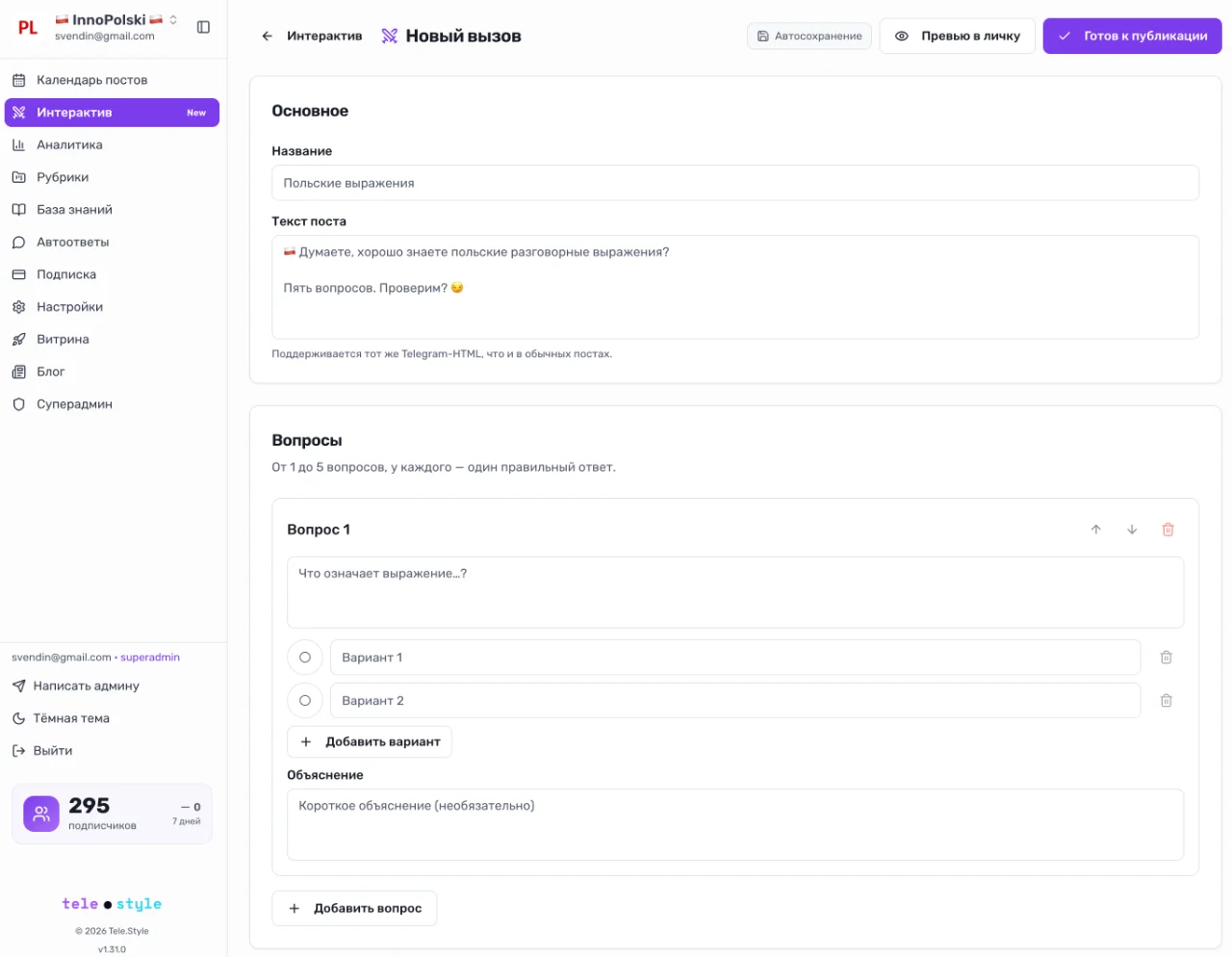
- The creator sets up a Challenge and publishes it in the channel.
- A reader opens the public page, enters a display name, and answers the questions. They do not need to register with Tele.Style.
- After finishing, they see their result and, if the timer is enabled, their completion time.
- The participant creates a personal invitation and sends it to a friend.
- The friend takes the same Challenge and can compare their result with the person who invited them.
- Once they have finished, the new participant can pass the Challenge on as well.
This creates a loop: Challenge → completion → result → personal invitation → comparison → new invitation. It does not guarantee virality, but it does remove unnecessary effort: participants do not have to write a message or explain the rules. Telegram’s official sharing mechanism lets users share a link with pre-written text, which they can edit before sending, as confirmed by the Telegram documentation on sharing links.
A single Challenge can include one to five questions, two to six answer options, the correct option, and an optional explanation. You can enable time tracking and choose how long the Challenge remains active. After it is first published, the content is locked for editing so that the conditions stay the same for every participant.
When Challenges Are a Good Fit for a Channel
The best Challenge tests knowledge or a skill related to the channel’s topic rather than random trivia. This allows the game to entertain, demonstrate the creator’s value, and introduce invited participants to the channel’s context at the same time.
Expert Channel
A marketer could ask participants to distinguish a viable hypothesis from an attractive but useless metric. A lawyer could test their knowledge of common contract terms. A financial advisor could ask them to identify a risky decision in an everyday scenario.
This kind of test works as a compact demonstration of expertise. The key is not to turn it into an exam full of traps. A good result should feel rewarding, while a mistake should teach the participant something.
Educational Project
A Challenge can be placed at the end of a themed week or module: five questions on the material covered, clear explanations, and a limited active period. A timer is appropriate when quickly recognizing a fact or solution matters. If the task calls for careful reasoning, it is better not to track time.
Business or SaaS
Instead of a “How well do you know our product?” test, it is more useful to diagnose a problem. For example: “Where is your content workflow wasting time?” or “What risk is preventing you from publishing regularly?” However, Challenges have correct answers, so the questions should test real solutions rather than disguise a promotional survey.
Media and Professional Communities
Recognizable situations work well here: identifying an event from a detail, guessing a term from an example, or distinguishing a fact from a popular misconception. The topic should feel specific enough for the core audience while remaining clear to someone who has not subscribed yet.
If the channel is just getting started, prepare it for new visitors first: write a clear description, create a pinned post, and publish several strong pieces of content. This foundation is covered in the article “How to Launch a Telegram Channel in One Evening”. Ways to attract and evaluate traffic are covered in “How to Grow a Telegram Channel in 2026”.
How to Create a Challenge People Want to Pass On
\1. Define One Clear Competitive Hook
The title should immediately answer this question: what can someone prove to themselves or a friend? Compare:
- “Marketing Quiz” identifies the topic but creates no intrigue;
- “Can You Tell a Growth Metric from a Vanity Metric?” promises a specific test;
- “Can You Spot Five Editing Mistakes in One Minute?” adds a clear sense of pace.
Do not promise something the Challenge cannot measure. Five questions cannot determine someone’s professional level or provide a diagnosis. They can test knowledge of specific principles or the ability to recognize a common situation.
\2. Keep It Short
For a first launch, three to five questions is a sensible range. One is often too few to create a meaningful sense of achievement, while a longer format raises the barrier to entry: invited participants open the link, see many steps, and put it off.
Start with a medium-difficulty question, follow it with an easier one, and add the most debatable or competitive question closer to the end. This progression helps participants get into the game quickly and keeps them interested until they see the result.
\3. Make the Options Plausible
If the correct answer is obvious from its length or wording, the competition loses its point. Incorrect options should reflect real misconceptions rather than serve as filler jokes.
An explanation after each answer is especially useful when an honest mistake is possible. One or two sentences are enough: state the principle, clarify the distinction, or give a short example. That way, even losing leaves the participant with a useful takeaway.
\4. Use a Timer Only When It Makes Sense
Time adds a second dimension to the competition. Two people may answer every question correctly, but one may do it faster. This works well for terminology, visual recognition, simple calculations, and facts.
A timer gets in the way when questions are long, depend on nuance, or require an ethical judgment. In this type of Challenge, speed is more likely to penalize careful thinking than demonstrate skill.
\5. Choose an Active Period That Fits the Theme
A short active period works well for an event, livestream, or themed week. A longer one is better for a pinned introduction to the channel and evergreen content. Tele.Style offers active periods ranging from 24 hours to 30 days, as well as an unlimited option; new Challenges default to seven days.
It helps to mention the timeframe in the post: a specific deadline gives participants a clear reference point. But do not create artificial scarcity if the Challenge will remain relevant for months.
How to Launch a Challenge in Your Channel
First, build the Challenge in the Interactivesection: add a title, post text, questions, answer options, explanations, timer, and active period. Before publishing, take it as a participant and check three things: whether the questions make sense without additional context, whether two options could both be considered correct, and whether the wording gives away the answer.
Then prepare the post. It should explain the game in a few lines:
Five situations where a channel loses readers. Find the right solution and challenge a colleague. The timer is on—if the scores are tied, the fastest participant wins.
Once published, the questions and answers cannot be changed. This keeps results comparable, so the final review matters more than the usual “we’ll fix it later” approach.
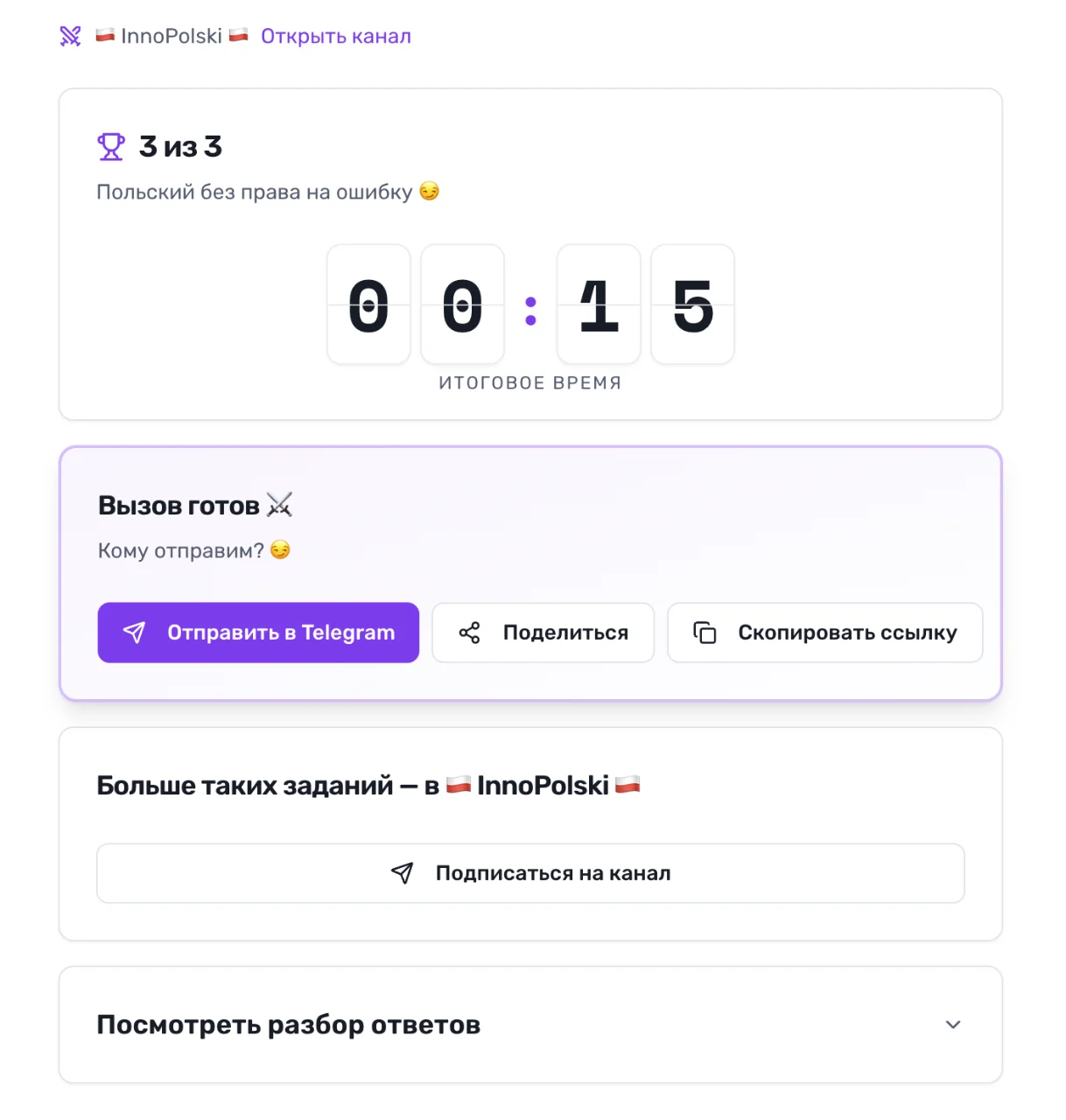
During the first few hours, the creator can take the Challenge and share an example result without revealing the answers. After that, avoid making a generic request for the audience to “share the post.” Instead, tie the invitation to a specific person: a colleague who always argues about metrics, a friend who is confident about their geography knowledge, or a course participant who solves tasks faster than anyone else.
A Challenge does not replace regular content. It gives a burst of activity structure and momentum, while the channel needs to welcome new people with a consistent feed. A separate guide explains how to build this rhythm: “How to Post Consistently on a Telegram Channel: 9 Practical Techniques”.
What to Evaluate After Launch
Do not look only at the number of views on the original post. Four questions matter for this format:
- How many people started the Challenge;
- How many completed it;
- Whether participants are joining through personal invitations;
- Whether the new audience explores the channel after playing.
Even without sophisticated attribution, it is useful to compare two launches: the topic, number of questions, presence of a timer, active period, and wording of the post. Change one significant element at a time; otherwise, you will not know what affected the result.
Do not judge quality by the average score alone. A very high score may mean the Challenge is too easy, while a very low score may indicate that the questions are confusing. A more important signal is whether people want to finish and invite someone else to take the same Challenge.
Mistakes That Break the Chain
Context that is too narrow. Regular readers understand an inside joke, but an invited friend does not. The questions need to work outside your feed.
An exam-like tone. Wording such as “prove you’re not a beginner” may motivate a small part of the audience but put everyone else off. Friendly competition usually leaves more room for mistakes.
An unrelated topic. A movie quiz may generate reactions in a finance channel, but invited participants will not understand why they should subscribe. The Challenge should lead back to the channel’s core value.
Artificial difficulty. Trick questions, double negatives, and answers that differ by a single word test the editor’s patience, not the participant’s knowledge.
No next step. After seeing the result, participants should be able to understand who created the Challenge and what to read next. Prepare a pinned post, a themed collection, or an upcoming content series that continues the topic.
From a One-Off Game to a Recurring Format
Treat the first Challenge as an editorial experiment. Choose one topic, three to five questions, and an audience that would naturally want to compare results. Run it for a limited period, gather observations, and only then turn it into a series.
A good series can run weekly, conclude an educational module, or accompany an important piece of content. Change the subject matter between editions, but keep the core format recognizable: a consistent difficulty level, a clear promise, and honest explanations.
A practical next step: open the Interactivesection in Tele.Style, create a short Challenge based on your channel’s core topic, and ask someone who has not seen the draft to take it. If they understand the rules, complete the test, and immediately know whom to invite, the Challenge is ready to publish.
Quiz
What turns a Tele.Style Challenge from a regular quiz into a mechanism for organic growth?
- A larger number of difficult questions
- A personal invitation with the result, a comparison, and the option to pass the Challenge on
- Mandatory registration for every participant
- Automatic publication of the correct answers in the channel